Showing posts with label rewilding. Show all posts

Saturday, 5 September 2015

WILD10 Global Gathering presentation: Rewilding Tigers


I was honoured to be invited to speak at the 10th Wild Congress about rewilding tigers and to be reported by the congress as one of the "Unsung Heroes" (http://wild10.org/blog/unsung-heroes-li-quan):

At the 10th World Wilderness Congress we discovered hundreds of young activists who were working quietly behind the scenes to make the WILD vision a reality. We felt that these people’s activities should be recognised. In keeping with the knowledge that young people are the future, we asked our team of young trainee journalists in the press office to go out and interview them.

Thanks to the World Bank, which acts as global sponsor, there are more than twelve countries involved in the conservation of tigers nowadays. However, when Li Quan started to work for this beautiful animal, she was almost on her own.

It was thirteen years ago when she started the Save China’s Tiger project. As she explains: “All tiger are in danger, but theSouth Chinatiger is particularly threatened, it is critically in danger.” By 2001 some organisations even considered this animal an extinct species, but Li Quan thought: “I’m not going to accept this”. She wanted to helpChinaand she decided to do something about it.

This young woman is proud to be one of the first people to use the word that is much bandied about at WILD10: rewilding. Nowadays this is a commonly accepted term when talking about conservation with many scientists working for it, but back when Li Quan started her project, nobody believed this could be possible.

She had big plans for South China tigers and decided to take these animals from Chinese zoos to South Africa, where there was the infrastructure for ex situ breeding. New offspring are raised there and, when they are mature enough, they are brought back to China; not back to zoos but to the wilderness. A second generation of South China tiger has already been released and so far more than eleven tigers have started to procreate in the wild.

“Thirteen years ago the tiger population was going down and down, now it has been proved that there was a point in what I did”, says Li Quan. “Thanks to this, we are recovering tigers, we are rewilding China”. She feels very committed to the 10th World Wilderness Congress, since its founder, Dr Ian Player, has supported her since the early beginnings of the Save China’s Tiger project. “Now we have Rewilding Europe and other projects, so this is not controversial, but 13 years ago it was”, she explains.

Li Quan does not care about PhDs or renowned prizes, she just cares about tigers and other threatened species. “I don’t have a PhD in Biology, but it doesn’t matter, because anyone can protect and ‘make the world a wilder place’. Without wilderness, we can’t do anything and I hope my story helps inspire other people, especially young people.”

Regarding this, she claims there is no magical formula. “We just have to talk more to children. It’s all about talking. If we have more messages, more people will get involved”. WILD10 seems to be a perfect forum to start spreading these messages.

Interview conducted by Elisa Hernández Sánchez – born and raised in Salamanca, Spain, Elisa is a translation and interpretation graduate, has a Masters in Secondary Education, and a Degree in Art History. On top of all this, she is interested in sustainable communication and cultural dissemination.

Tuesday, 10 July 2012

South China Tiger Rewilding Guidelines - First Step to the Reintroduction of Captive Bred Tigers to the Wild

-Authored by Li Quan

I would like to thank the many scientists who gave me input in drafting this document, which is an accumulation of my 13 years of tiger conservation work, which started in 1999.
At the International Wildlife Management Congress (IWMC 2012), the South China Tiger Rewilding Guidelines was officially released. Since 2003, I have undertaken an unprecedented project to rewild zoo-born South China Tigers in South Africa to prepare them for their eventual return to their natural habitat in China in conjunction with China's Wildlife R&D Centre of the Forestry Academy. This pioneering project was ground-breaking in many areas: applying an unconventional approach and utilizing the expertise of a different country in a foreign location to fast-track the recovery of the most ancient, yet most endangered tiger in the world.
Below is an abstract of the Tiger Rewilding Guidelines that I have applied and a full version in both English and Chinese can be obtained here: http://www.savechinastigers.cn/file/2013/RewildingGuidelines.pdf 
Abstract*
Many wildlife management projects have been conducted throughout the world that may involve: rehabilitation, re-introduction or translocation. Few of these activities have successfully been conducted using captive bred predators. Rewilding describes the processes in which carnivores that have been in zoo conditions for generations and have no survival skills for the wild, re-learn the hunting and skills in a natural environment to prepare them to be reintroduced to the wild.
The South China Tiger (Panthera tigris amoyensis) is recognised by the IUCN as the most endangered of the remaining six extant subspecies of tigers. There are believed to be fewer than 30, if any at all, left in the wild. The only option to revive this tiger in the wild is through reintroduction of captive-bred individuals. OUr project aims to utilise rewilded captive bred tigers and their offspring as catalysts to restore and secure habitat for their release in China.  In the wild, offspring of tigers are known to spend up to 28 months with their mothers when they acquire and develop hunting and survival skills. Captive-bred tigers lack these essential hunting skills and need to be rewilded before they can be reintroduced.
Tiger rewilding initially started in China in the 1990’s. South Africa was used to fast track the rewilding project. Five tigers were transferred from zoos in China to South Africa since 2003.
The tigers have been confined to one area of the reserve, subdivided into different-sized camps (0.5 to 100ha), depending on objectives for individual tigers. The number of camps increased over the years as the number of tigers increased, and the sizes of the hunting camps were modified as tigers became more experienced and skilled, and to accommodate the tigers’ development and mimic their movement according to their age. The tiger camps are secured with electrified fences.
There are three categories of camp sizes, according to the age of the tigers and their ability to hunt: quarantine/smaller camps, intermediate camps, advanced rewilding camps. All camps are equipped with natural or supplemental water supplies.
The Rewilding methodology was initially developed for us by Gus Van Dyk, former Carnivore Manager at Pilanesberg National Park of South Africa, and been fine-tuned throughout our rewilding programme, which has followed “Adaptive Management” procedures. The methods have evolved as the project progresses, to suit the changing needs and situations.
Zoo-born tigers that originated from China, were introduced to ungulate prey where rewilding involved “self-taught” or "trial and error" learning. Second generation tigers born in South Africa, were rewilded by: 1) learning survival skills from their mothers-“Natural Learning (NL)”, and 2) a combination of mother-teaching and NL without their mother’s accompaniment.
Components such as “Pavlov” training, prey species and their sizes, animal and human safety procedures, human habituation, veterinarian provisions, data collection/monitoring, treatment, and ethics are discussed in the rewilding guidelines.
Details of fencing structure, camps characteristics, prey species for hunting training and feeding, as well as monitoring sheets are also included in the rewilding guidelines.

Thursday, 28 June 2012

Summary of US Congressional Briefing on June 22nd 2012 by Smithsonian Zoo and Save China's Tigers


The Smithsonian Conservation Biology Institute's Director Dr. Steve Montfort, and Save China's Tigers' Founding Director Ms. Li Quan, co-presented at the ICCF congressional briefing on June 22nd in Capitol Hill.

Below is a summary of the briefing:

The Role of Reintroduction: Ensuring the Continued Existence of Species in the Wild

The drivers of human-wildlife conflict often place enormous pressures on entire populations of flagship species. These threats can be so severe that, once dangers have been addressed, existing populations need to be supplemented with animals raised in captivity.

Both the Smithsonian National Zoo and Save China’s Tigers are pursuing innovative means of species preservation through reintroduction.

Dr. Monfort of the Smithsonian Conservation Biology Institute outlined the ways in which zoos can leverage their resources to reintroduce species on the brink of extinction into the wild.

The Smithsonian believes this method of species conservation will be increasingly important for the future, as the number of endangered species has increased steadily over the past ten years.

Save China's Tigers is leading one of the most famous current "rewilding" programs - first introducing South China tigers in South Africa, which offers ideal conditions for the tigers to relearn to hunt, and eventually releasing them back into South China.

In 2008, the organization had observed their greatest milestone in a pair of tiger cubs born in South Africa in the wild, after four years of training the tigers' parents to adapt to the environment. 14 tigers are now under Save China's Tiger, 11 of them born in South Africa.

Friday, 3 February 2012

MICROCHIPPING MADONNA’S LOTTERY WIN

Madonna and Cubs

Jan 28, 2011

Everything was going according to plan. We managed to get Madonna into another camp leaving her 3 babies alone so we can walk into the camp, catch them and microchip them. Joseph was called immediately and it would take him 2.5 hours to drive from Kimberly, but unfortunately he had to take care of an emergency veterinary operation for a horse somewhere first.

I informed team my rough idea:  we were to station ourselves at different locations of the camp, thus preventing the cubs from getting close so they could potentially crawl under/through/over the fence, all of which had been part of our Laohu experience!  And we were to catch the cubs with capture net and fishing net, a effective and harmless technique learned from Chinese zoos. In the end we agreed on a plan, that just before the vet arrives we would proceeding with the operation and two of the three cubs would be put into each of the two travel boxes while a third will receive microchip. Microchipping itself doesn’t last long-it’s the preparation that takes time. But having had plenty of experiences and learning from past mistakes I think our plan covered all grounds. However more often than not, dealing with nature does not go according to plan. 
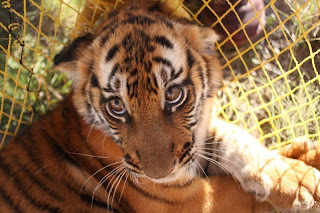
Xa in the net

I was so looking forward to it. Not that I care so much about the microchipping which is a government requirement, but we could use this opportunity to sex the cubs. Last week, I was telling our tiger supervisor Vivienne that for some reason all the three cubs I observed through my cameras and binos were females. Was I imposing my wish on what I saw? Vivienne said the next day that she definitely saw a male. Well, I said, in that case hopefully we had at least two girls. We badly need more female tigers to address the imbalance between males and females in our second generation South China Tigers born in SA.

One hour, two hours passed. Still no news from Joseph. I was worried about the cubs as today was quite a sunny day. We moved the little concrete water tray next to the big tree which they preferred. Madonna showed up from the deep thicket of 7 Ha camp and watched the commotion, attentively. As soon as they saw mom the cubs all came out to the fence trying to get to mom. At one point one of the cub was zapped by the electrified tripwire which immediately got Madonna to return to the fence, just when she was about to head back into the cool thicket.

It was not until 5pm before we heard from Joseph, but he was only one hour away now from us.

We sprang into action. We used the big capture net to form a barrier so if the cubs would run they would get caught into it. Then we approached the cubs who were now all cowered into the corner of the camp. Madonna, watching from the other side of the fence, started charging the fence at us but got shocked by the electricity which made her even angrier. I kept telling her we were not stealing her babies and they would be fine but all the same, she gave us menacing growls and charges.

Yoya

It turned out to be fairly easy to scoop up the first and second cub with the fishing net, however they tried to threaten us with their little snarls. They were still quite small though very solid and strong. They were put into two cages. The last one was a bit of challenge as it escaped the fishing scoop and ran to the capture net, where it got caught.  Hein scooped it up and Joseph was, as usual, very quick in his actions and micro-chipped the cub. Time to sex the cub! A girl! She was given a temp name Xa.

The second microchipping also went very smoothly as the cubs seemed to freeze once they were caught. We took head shots from different sides and body shots in order to identify them, as they looked remarkably similar. I lifted her leg to sex her, yet another female!! She was nick-named Yoya and like the first one she was immediately put back into her Ravine camp and she also ran straight into the dense vegetations of the stream.

The third one proved to be more difficult to handle. First we had trouble getting the cub out of the cage. Then the cub was fighting us. We managed to get the chip in and photos taken in the end, not without a bit of casualties. At one point my finger was bitten but no harm done. However, Thinus (our assistant reserve manager) got a bit on his arm, which still looked bloody after the operation completed.

Well what is the chance that ALL 3 cubs in our FIRST ever TRIPLET litter are ALL girls?? When I gently lifted the cub’s little but strong leg, I couldn't contain my excitement! INDEED, ALL 3 of Madonna’s cubs are baby girls!!!!  

WE WON A LOTTERY! AND WE ARE ROCKING!!  We named her Zeta for now.

Feb 2st  2012

Yoya being examined
After Microchipping, we left all the gates connecting three camps open, hoping Madonna would reunite with her 3 cubs overnight. However, the next morning on Jan 29th she was found inside the 2 Ha Ravine camp with two cubs, pacing with another cub on the other side of the fence inside 7 Ha Catkins camp.  For the whole family to get back together, either the lone cub had to come through to the mini-management camp to the Ravine, or Madonna had to come to Catkins to fetch her. During afternoon monitoring this had not yet happened. We managed to coax Madonna into Catkins, hoping the lone cub would follow her back into Mini-camp, then back to Ravine. But the cub refused to cross the threshold. It had to be the same cub that refused to cross the gate in reverse the other day! We left them for the night but by this morning, the status quo remained the same. I had to find ways to get them all back together so Madonna doesn’t have to be caught spending time with two households. The best method again, is the fishing scoop net.

But easily said than done! The cub was much smarter than us! And certainly a lot faster than us! We spent the day yesterday figuring out way to catch her, using Madonna as lure, but needless to say we failed. Her little told her not to trust us and her little legs can certainly run. In the darkness we abandoned our effort to reunite the family and let Madonna decide if she should spend time in Catkins or in Ravines and with which cubs, leaving the two gates between the three camps open. It was not without pity that I retired for the evening, thinking how much of a challenge it was for a tiger mother. Despite having to go back and  forth between the three camps, at no time did she express any sign of anger or impatience to her screaming and demanding cubs, and always showered them with tenderness and patience, no matter how helpless she felt…

The next morning, one more cub moved into Catkins and the cry of the lone cub in Ravine camp was loud and clear. Despite that the eland was not completely finished though Madonna’s family did an impressive job eating most part of it, we decided to give Madonna some fresh carcass. Thinus shot two blesbok and tied them together in the mini-management camp to prevent her from dragging it away, and Vivienne blew the whistle. This time however, Madonna refused to come out to the sound of the whistle or food. She must be getting back to us for using a springbok as bait last night but not giving her the full deal!
Zeta in the net

Another night and no one appeared, not even Madonna. At this point I began to worry seriously that should the cubs be split too long, Madonna could lose patience and stop caring one of them. I doubt tiger mothers do that but still I feared. We had no idea where Madonna was or any of the cubs was. I decided that we should be on whole day monitoring so our staff would do the observation in turn. But by 4pm, not even a shadow of anyone in sight. I was praying that this would be a sure sign that Madonna and her cubs had all gotten together. By 5pm however, only Madonna and one cub was sighted but they soon also disappeared, which made me worry seriously once more.

A tiger-loving journalist from Hong Kong was visiting us to report on our project yesterday. Just when I was prepared to tell him that he was out of luck with Madonna’s cubs and that my team ought to prepare for a day search the next day, when all three cubs were spotted grouping together on Catkins side of the fence line with Ravine Camp.  I was elated..

Zeta taking temperature
I drove into Catkins camp with Ivan the journalist, and we were soon reward with the most incredible sighting: Madonna strolling with three tiny cubs trailing behind her, towards us. She seemed a bit startled when she saw my vehicle, but calmly went into tall grass and lied down just a few meters from us. The cubs, with the aid of the onset of dusk, appeared to be bolder than usual, moving even closer to our vehicle. They soon joined mom demanding milk from her. The they played, chasing one another in the grass and amongst trees. As the light dimmed further, the cubs seemed even more bullish, with one of them approached our vehicle to within 5 meters. She was then distracted by the big stone and started investigating it: looking from one side to another and climbing on top etc. This undaunted little cub turned out to be Xa.

At sunset of today’s sunless day, I again saw Madonna’s family of four. While mom was feeding in adjacent camps, the cubs put on the most exciting show in nature’s stage: chasing and tumbling on top of one another, wrestling and hugging etc. When mom finished eating, they jumped on top of mom demanding to be fed, to which Madonna obeyed obediently and with such love and gentleness. She licked and hugged her cubs tenderly and watch them frolicking with such pride and content..


-From Li Quan at Laohu Valley Reserve, South Africa

Friday, 2 September 2011

Not Everyone Likes Huwaa


The little baby tigers showed their little faces sparingly during the last few days when the Chinese reporters came to visit, while Cathay continued to patrol around her camp, warning all the nosy boys off her and her babies butt. After all the strangers had left, mom chuffed her babies out of the donga to have a good straddle around. The little boys wobbled onto a patch of dry grass in succession and it was clear they were starting to play, though they were still so unsteady. They waved their fat little arms as if pounding the other one and climbed on top of one another. Their achievement today was climbing a thick branch of a big tree about half meter off the ground. The first one managed pretty quickly but the second cub pondered over it for quite some time before making the attempt. He succeeded only half way, getting off the branch the way he climbed up, while the first cub disappeared from the other side.

Seeing that Madonna’s hind legs had been loosing condition and needed some exercise, I decided to also let Madonna to go into the hunting camp with TigerWoods and Huwaa on Sept 27th, if her test meeting with Huwaa was not too dramatic. She may be pregnant, and if so she might not be able to have any hunting exercise for yet some more months to come if she gives birth mid-September. It would anyway be good to have two hunting teachers. Madonna didn’t show much emotion towards Huwaa when eventually all three were let into the mini camp just before going into the Tigers' Roars, so the gate was opened to let them move into it.

TigerWoods was the first to go in and having been absent for several years from it, he explored and sniffed. Huwaa followed him in, playing with his tail which annoyed the hell of him. However, all the male tigers had been very patient with her, allowing her rather energetic taps on their butts, however irritating that is, but running away sometimes. Huwaa was distracted by the humans watching her, letting step dad getting away steadily, disappearing into the trees. Afraid that she may have no one to follow in a huge new camp, I got all humans into vehicles, thus damping all of Huwaa’s hope of playing with them. Madonna uttered a little unpleasant sound after she entered the Tiger's Roar and when Huwaa tried also patting her butt. She didn’t make a huge fuss, allowing her trailing behind by a few meters, when the two also disappeared into the trees.

When we checked on Huwaa yesterday morning in her new home, she only came out when the predator whistle was sounded. She was not in a hurry thought she was very happy to see all the human visitors. Perhaps she was allowed to share some of the two blesbok kills TigerWoods and Madonna made over night? We couldn’t be sure but she didn’t seem to be hungry-just showed off her acrobatic skills. In the afternoon, she answered her rote call from across the little river, jumping and diving across the river and into the grasses. There was still no begging for food. It made me wonder if she was feeding off TW or Madonna’s kills?

This morning, I wanted to check if she was actually spending the past two nights on her own or with an adult tiger so we rote called with predator whistle. Only Madonna came, while TW was still nowhere to be seen. Madonna however was not that friendly to Huwaa, snarling at her. But no fight seemed to have broken. It was clear that Madonna was not Cathay and did not treat Huwaa with the same care and patience.

It was not until this afternoon when I realized how much grudges Madonna bore towards Huwaa. As usual, Huwaa answered my rote call and came to where I was standing by the gate. But from the corner of her eyes she saw Madonna in the distance by the little river and froze. When Madonna started making her way over towards us, Huwaa suddenly turned and run like a fugitive towards the opposite direction along the fence and up the hill, tail between her legs and checking her back to see if Madonna might be close. My calling after her was not enough to stop her. I realized there must have been something wrong and only managed to catch up with the little girl and slowly coached her back to the gate by assuring her that I was there to protect her, hoping to get her out of the Tigers' Roars. However, Madonna had arrived. She uttered a menacing snarl and charged towards Huwaa. Poor little Huwaa at least knew how to run and to avoid Madonna’s aggression. There were a few near misses as Huwaa tried to reach the gate which I was waiting to open for her, but which Madonna decided to guard against and chased Huwaa around. Only the approaching sound of Vivienne’s vehicle distracted Madonna a little so I was able to get Huwaa out of the Tigers' Roars camp and into the mini camp. She was grateful to be over the ordeal and rubbed her head gently against my leg and followed me through Catkins Camp into quarantine and then into the corner camp where Cathay was waiting for her.

Mom is mom. Huwaa needed the consolation. Unlike the snarls and hisses that Huwaa received from Madonna, she was showered with from mom before they were even let into the same camp with Cathay. Huwaa unleashed all her pent-up feelings onto her mother and jumped about Cathay energetically. Despite her hunger Cathay bore patiently Huwaa’s antics, allowing her to abuse her good self. Even when she was fed up with all the pounding on her butt and her face and wanted to talk Huwaa down, she was gentle -careful not to hurt her. The difference between Cathay and Madonna’s attitudes towards Huwaa couldn’t be more clear-tiger mothers recognize their own offsprings! There was no doubt that Madonna knew Huwas was Cathay’s baby and was nasty to her. Jealousy? I have no doubt.

Meanwhile, Huwaa’s hunting training has to wait for a few weeks, till Madonna and TW have finished hunting in the Tigers' Roars…


Aug 28th, 2011
TigerLi in Laohu Valley

Tuesday, 23 August 2011

Huwaa Meet Her Baby Brothers

A cold front came in last night, but Cathay and her babies stayed outside the breeding centre, which we allowed for the first time. This morning I saw the babies well sheltered from the hauling wind between the tree trunk and the wooden shed, huddled around each other.

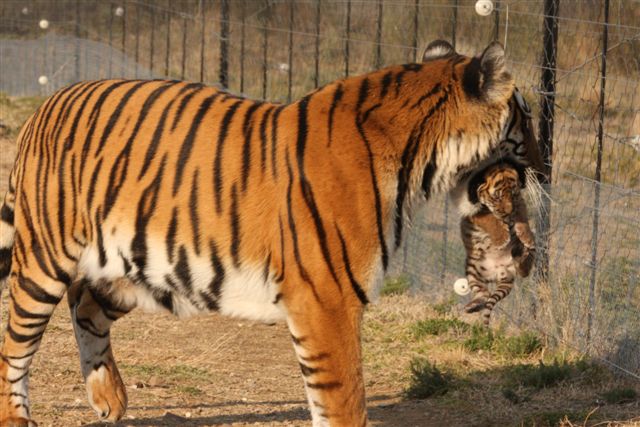
Huwaa, who had been waken up by our morning call, was trying her best to get us pay attention to her. The baby tigers saw that and walked wobbly out of their hidden spot towards her but stopped midway. Seeing that, Cathay went over and gently lifted each one up in her well-controlled mouth and moved the babies close to the fence where Huwaa was getting excited on the other side of the fence. She was so thrilled to see her baby brothers for the first time and she tried to reach out to them through the fence to play with them. Fortunately the metal mesh stopped her paws from getting through, as being still a child herself, she would have no idea how fragile her baby brothers are and how they could simply be played to death by her.

Cathay retreated into the wooden shelter and simply kept a watchful eye, secure in the knowledge that her little daughter could not accidentally hurt her babies due to the fence between them even though Huwaa has no idea how deadly her paws and teeth could actually be. The little cubs seemed to know the creature on the other side was their elder sister and tried to reach out to her. They stood up on their not-yet-so strong little legs in that attempt to get closer to Huwaa. Thus they played and played..

Cathay certainly couldn’t have found a better baby sitter than Huwaa who kept her increasingly feisty cubs entertained. I feel greatly relieved as well, as I have plans to put Huwaa back with both her mom and her baby brothers together a few months down the road so they can all learn hunting from mom Cathay at the same time.

After a while, Cathay decided that they had enough excitement and proceeded to gently gently carry the first baby back to the hiding spot. Except that the little cub wanted more of his elder sister and walked wobbly back to Huwaa while Cathay was carrying the second cub back to their shielded spot. But on hearing the cry of his little twin brother, the wandering cub went back into the comfort of his mom’s care and his brother’s embrace, where they dreamed their day dreams through the cold windy grey day...

The reason that Cathay and her two cubs were kept in the breeding center/quarantine camp during the first month of their births was to shield them from potential predators that could take their lives, as happened to another of Cathay’s cubs in Dec 2009. Now that they can walk, a bit wobbly albeit pretty speedy, I decided to let them move into Ripples camp where they can grow up in a natural environment.


Wednesday, 7 April 2010

Victory Does Not Come Easy in 100 Ha Camp!


Rambling Rose


A pair of brothers

Another pair of brothers

The Brothers in Hunter Palace


ITV news crew was so lucky. They were here to report on our story and while we were filming Hulooo brothers in the new 100 Ha camp late afternoon on March 25, 2010, we saw King Henry and Princess hunting across the open grassland, chasing the 15 blesbok. In no time however, we heard distress calls, which caught the attention of Hulooo brothers (that were being filmed), who took off immediately in the direction of the kill.

We drove quickly into 40 Ha and found King Henry and Princess in the riverine area, with King Henry playing with and subsequently protectively guarding his kill when we approached. Dr. Gary Koehler who was visiting remarked: "Li, I can see this will work!"

Next day was the first time we EVER drove inside a camp where 327 is around. As we knew, 327 loved humans and was very fond of playing with us when he first arrived at Laohu Valley.
I had to let him into the 3 Ha wilderness camp eventually after he refused to mate with the tigresses, and amazingly he became less and less interested in us humans. He stopped standing up trying to play with us and later even stopped coming to the fence to greet us. These were all very good signs. What amazed me even more was when I decided to let Cathay try again mating with him, he performed and became a father in December last year!

In the past I would have never dreamed of driving into a camp with him, wary that he might stand up against the vehicle. However, now that he seems to be behaving more like a wild tiger, I decided to take the risk and see his reaction towards us humans. I took Dr. Gary Koehler inside the 7 Ha camp in the Rhino and 327 was right at the gate. However he showed no interests in either our vehicle or us people. We drove next to where he was lying, he even walked away. What a positive change!

I had some trouble though! 327 decided to "possess" me by spraying. He didn't do it just once! Twice he directed his spraying intentionally at me and his juice shot right inside my open Rhino, covering my full face and body. I felt however proud that he was marking me as part of his territory, against his rival TigerWoods, who lay on the other side of the fence observing him.

Eleven weeks passed since Cathay mated with 327 and she still has not come into oestrus (she is with 327 in the same camp for monitoring). According to our experience, this means she is pregnant! If that's true, we should be expecting her and 327's babies around 20 April. 10 weeks had also gone by since Madonna mated 327. If our past experience is any indication at all, Madonna is also pregnant and should deliver beginning May.

It rained all night and pot holes popped up on the dirt road leading to Tiger camps, and when we arrived in the 40 Ha camp in the early hours of March 26 2010, King Henry was lying in the grass, with a half eaten kill lying a few meters away- another blesbok lost its life overnight. Then one more blesbok was taken in each night of Mar 29th and March 31st.

Meanwhile, ten days into the 100 Ha camp, Hulooo brothers are still trying to find their feet. They weren't being fed for about 4 months while King Henry and Princess occupied the 40 Ha hunting camp so were becoming a bit reliant, like many spoiled teenagers do. From time to time, they would chase the blesbok but for the most part, they spent their time exploring and sniffing the new large area. Tigers are territorial, they must familiarise with every piece of rock and every blade of grass in their domain.

On March 31st, JenB and Coco turned to 2 years of age. Seeing that Hulooo brothers didn't have the will to hunt, I decided to first put them back into the 40 Ha camp, where they hunted only too well before, to get their drive back in familiar ground. I also wanted King Henry and Princess to go into 100 Ha, seeing they have been hunting for 4 months successfully in 40Ha.

It proved to be a challenge to swap the two groups of tigers. It took several days and some re-work on the iron gates linking the two camps before we finally succeeded in getting them swapped. Hulooo brothers were certainly busy, as they made 2 kills in the first night, and one can see their confidence was back as they no longer whined for food when we finally found them among the trees, just quietly enjoying our company.

King Henry and Princess were not idle either. We saw them busy stalking prey the second day inside the 100 Ha camp. 4 days into 100 Ha they were still not successful. King Henry came to the Gate when he saw us Monday April 5th, but left with the look of disappointment when he realised no food were forthcoming from his human carers. He ate grass while he walked away in the thunderstorm as if protesting. He also tried to call his sister-the first roars we ever heard from him. We were just going to give them another day to see if they would catch anything before we fed them. It would not be good to starve them too much that they loose the strength to hunt.

The next morning April 6th, we first tallied the number of blesbok in 40 Ha -three blesbok missing. Good hunting weather certainly aided Hulooo brothers who were getting too good. And in 100 Ha, it was much harder to count the blesbok. We counted numerous times and would not believe that the actual number had indeed dropped to 42 from 43, though we were all praying for that. Well, we could no longer deny the fact any more- King Henry and Princess had actually made their first kill in the 100 Ha camp overnight! These young ones also took advantage of the bad weather and their victory made history.

Thursday, 21 May 2009

Why Why Why?!

It puzzles me more and more that Cathay has still not come into estrus. Over eight months have passed since she was separated from her sons JenB and Coco. We have been informed by various sources on the estimated time it would take for a tigress to come into estrus after separation from her cubs. Shanghai Zoo, with one of two largest breeding population of South China Tigers in China, said it normally takes two to three months after cubs are taken away from her, usually when the cubs are three months old. Other source says records taken from captive cats show a range of 75 to 592 days. Still another says it takes seven months.. It is very difficult to observe such events in the wild, so our project could be an ideal platform for finding out the situation with a wild tigress.

Anyway, we have done all we could. We moved her far away from her cubs so she could not see them for quite a while. We let her hunt for a few months to "forget" about her cubs. Having exhausted all available strategies, we decided to separate her from TigerWoods for a while, and putting her next to 327. I recall how excited she was when she first met 327 two years ago, chasing him around in the most enticing posture, and it might just take 327 again to excite her system. Some tigers seem to need just the presence of one potential mate. But other tigers are more like cheetahs, who would only come into estrus when there are more than one male present.

Cathay is such an intelligent cat. She seemed to know what we had in store for her and it was easy to get her leaving TW behind, and crossing three gates into the camp adjacent to 327 on April 29. New smells abound, as Madonna and her cubs spent quite a while here. Cathay was absorbed by the smells, busily sniffing and spraying.

May 4th, we let Cathay into 327's camp. We did this with much trepidation, as I still recall how 327 was terrified of Cathay and how they might end up fighting if he defends himself. To my complete surprise, 327 was extremely friendly to Cathay! All this year and half of life in the wild and in solitude may have served him well that he certainly became more of an gentleman. The two played a few games of hide and seek. Seeing nothing harmful happened to them, we decided to let them overnight together. Next morning, we came to see if anything dramatic had happened and were pleased all remained calm.

TigerWoods, however, are not very happy to be left alone. For several days, we heard him roaring, either calling for his mate Cathay, or complaining to us about being left alone. He refused to eat any food. Isn't this an expression of love by TW for Cathay? I don't want to be accused of endowing human emotions and values on animals but our evolutionary paths were the same throughout most part of our development. We must share similar emotions with other mammals. In the end, after a few days of hunger strike by TW, we did not have much choice but to decide to switch Cathay back and forth between TW and 327.

Meanwhile, King Henry and Princess are getting more comfortable in the 42 Ha camp, exploring further afield from the riverside area. For two days, after they made two kills, they even refused to come out. I was beginning to worry that the antelopes might have done damage to them. I was also worried that I might not see them for a while before I would leave Laohu Valley on May 10th. In fact, I made a bet of 50 US dollars with my friend  who came to visit during the weekend of May 8th, that they would not come out during our last afternoon drive. The sun was setting and I was about to drive out of the hunting camp and win my bet, when Vivienne spotted the silent appearance of King Henry! His demeanour had changed. Instead of making grandious announcement for his appearance, he quietly approached, as if stalking us. This made me more convinced that he made at least one kill this time, and was continuing to practice his successful hunting techniques now. I was relieved to see him, and to see he was intact.

Then, as if to grant my wish, Princess also peeped her little shy head from behind the tree branches, just when I started my truck's engine again. I was pleased that I had lost my 50 dollars completely by now, to say the least!!

I left Laohu Valley happy, but looking forward to my next visit again in a few months. So I still find no answer to Cathay's estrus mystery, except to say that she may be needing a rest after carrying two litters of cubs so close to one another. Madonna mated last year around this time. So if tigers do mate seasonally, as some say, Cathay should be mating now. May be soon? May be never? Maybe she will just keep me wondering why!!!

-TigerLi from SA, May 11 2009