Showing posts with label cat. Show all posts

Monday, 30 June 2025

New Book by Jasmine L. Quan – 'Gigia and Me! An Extraordinary Journey': How Her Bond with a Cat Healed a Broken Life


Jasmine rewilded tigers. Then she drowned in debt and despair—until Gigia, a fearless tabby, helped her reclaim hope, purpose, and a new path.

Gigia didn’t just walk into my life—she saved it. With her quiet charm, she reminded me of the power of love, laughter, and finding beauty in life’s smallest moments.”
— Jasmine L. Quan

"Cats know how to win our love without ever asking for it."

This simple yet profound sentiment captures the heart of "GIGIA AND ME! An Extraordinary Journey" (also available in Italian as "Il Dono di Gigia"), the inspiring new memoir by Jasmine L. Quan, which chronicles her life-changing bond with her cat, Gigia (pronounced as "JEE-jah"). Much like James Bowen’s "A Street Cat Named Bob", Quan’s story is a powerful testament to the transformative power of the human-animal bond—a connection capable of healing wounds, reigniting hope, and redefining life itself.
Jasmine L. Quan’s life has been nothing short of extraordinary. A former professional in the fashion and luxury sector, she traded couture for conservation, dedicating herself to the South China Tiger Project—an ambitious initiative to reintroduce tigers into the wild. Her work, featured in documentaries like Last Chance Tiger and covered by global media outlets such as The Los Angeles Times, Science, and the BBC, highlights her unwavering commitment to wildlife.


But even the strongest spirits can falter. After losing nearly everything—her career, home, and sense of purpose—Quan found herself at rock bottom. During this dark chapter, Gigia, a small domestic cat with a big personality, entered her life. What began as a chance encounter blossomed into an extraordinary partnership between a woman and a cat that would change both their lives forever.

"Gigia and Me!" is more than just a story about a woman and her cat—it’s a celebration of resilience, joy, and rediscovery. Drawing from her expertise in rewilding tigers, Quan applied her knowledge to create a rich and adventurous life for Gigia. Together, they explored Italy’s enchanting villages—from the sun-drenched shores of Calabria to the charming canals of Venice. Along the way, Gigia taught Quan invaluable lessons, and their journey continues.

"Gigia didn’t just walk into my life—she saved it. With her quiet charm, she reminded me of the power of love, trust, laughter, and finding beauty in life’s smallest moments," Quan says.

Packed with humour, heart, and practical advice, the book also features an easy-to-follow appendix with instructions for over a dozen cat tricks, making it a must-read for animal lovers and aspiring pet trainers alike.

"GIGIA AND ME!" is a heartfelt tribute to the magic of unexpected connections and the profound impact animals have on our lives. Whether you’re an animal lover, someone who has found solace in a four-legged friend, or simply seeking inspiration, this book will resonate deeply.

Title : GIGIA AND ME! An Extraordinary Journey
Author : Jasmine L. Quan
Publisher : Accornero Edizioni
Available Worldwide on Amazon: :
Amazon US: https://a.co/d/9XgQoUM
Amazon UK: https://amzn.eu/d/iIZcDwf


BOOK BACK COVER:

“Jasmine, once a tiger rewilder, found herself drowning in over four million dollars’ worth of debt. She was broken, and defeated. Enter Gigia, an emerald-eyed tabby born in a quaint Italian village.
Their extraordinary partnership unfolds into a gripping tale of resilience and transformation. Together, they challenge assumptions, shatter expectations, and inspire Jasmine to step back into the world.
What makes Gigia so remarkable, and how did she spark such a profound change?”

What other authors say about “Gigia and Me!”:
“A book as wonderful and magical as Gigia the cat!”
-Anthony Frewin, author of The Lion Of Canterbury
“A heartwarming and inspiring journey of determination, self-discovery, and triumph over adversity made more poignant and entertaining through the antics and devotion of one very colourful cat.”
-Lynn Santer, author of Sins of Life

ABOUT THE AUTHOR

Jasmine L. Quan earned a BA from Beijing University and dual MBA/MA degrees from Wharton and the Lauder Institute at the University of Pennsylvania. With determination, she achieved milestones across industries, managing Gucci’s global licensing before transitioning to wildlife conservation after witnessing the struggles of endangered species.

At the forefront of the South China Tiger Project, Jasmine led an ambitious tiger rewilding initiative, overseeing the breeding and training of more than a dozen tigers for over a decade. Her work gained global recognition in outlets such as The Los Angeles Times, Science, BBC, and CBS 60 Minutes, culminating in the documentary Last Chance Tiger.

She has authored two previous books. Today, Jasmine advises diverse industries, supports tiger conservation through her charity, China Tiger Revival (www.chinatigerrevival.org.uk), and is adapting Rewilded: Saving the South China Tiger into an audiovisual format on YouTube (@RewildingTigers).

"GIGIA AND ME!" is not just a book—it’s a celebration of resilience, love, and the extraordinary ways animals enrich our lives. Let Gigia’s story remind you that even in life’s darkest moments, a tiny paw can light the way forward.

Follow Gigia, the Travel Cat, on social media as she presents her own book on tour and explores Italy in style!
Instagram: @GigiaTravelCat
Facebook: @GigiaTravelCat
Facebook: Gigia And Me! An Extraordinary Journey
TikTok: @GigiaTravelCat
YouTube: @GigiaTravelCat


FOR INTERVIEWS, REVIEWS, OR FURTHER INFORMATION, PLEASE CONTACT:
Email: accorneroedizioni@gmail.com


Wednesday, 4 December 2013

The Trials of a Tiger Mother- China Daily Dec 4, 2013

In returning big cats to the wild, Quan Li has proven her critics wrong
Quan Li says she fell in love with tigers when she first saw them in a Beijing zoo as a girl, unaware that one day she would help save these tigers from extinction.
Quan, a former fashion executive who started a charity to help introduce South China Tigers back into the wild in 2000, has proven that rewilding tigers works, because the five animals she took from China to South Africa have now turned into 14.

Sunday, 7 July 2013

Important Correction on Article "Tigers Study Abroad" by the World of Chinese

I have added the following comment to the Article "Tigers Study Abroad" by "the World of Chinese" given the mixing-up in the article:  http://www.theworldofchinese.com/2013/06/tigers-study-abroad/#comment-34414: 

"I need to make an important correction.

I am NO LONGER affiliated with Save China’s Tigers (UK and Hong Kong). I ceased to be a director on August 2 2012.

I am a director of China Tiger Revival, an organization based in Australia and the UK, as well as a committee member of Save China’s Tigers (special fund of the China Green Carbon Foundation) which I initiated and co-established in China.

I am grateful for the continued support of my friends, scientists and patrons, volunteers and well wishers throughout the world and look forward to continuing our important work together.”

-From Li Quan, Founding Director of China Tiger Revival (Aus & UK)

Tuesday, 10 July 2012

South China Tiger Rewilding Guidelines - First Step to the Reintroduction of Captive Bred Tigers to the Wild

-Authored by Li Quan

I would like to thank the many scientists who gave me input in drafting this document, which is an accumulation of my 13 years of tiger conservation work, which started in 1999.
At the International Wildlife Management Congress (IWMC 2012), the South China Tiger Rewilding Guidelines was officially released. Since 2003, I have undertaken an unprecedented project to rewild zoo-born South China Tigers in South Africa to prepare them for their eventual return to their natural habitat in China in conjunction with China's Wildlife R&D Centre of the Forestry Academy. This pioneering project was ground-breaking in many areas: applying an unconventional approach and utilizing the expertise of a different country in a foreign location to fast-track the recovery of the most ancient, yet most endangered tiger in the world.
Below is an abstract of the Tiger Rewilding Guidelines that I have applied and a full version in both English and Chinese can be obtained here: http://www.savechinastigers.cn/file/2013/RewildingGuidelines.pdf 
Abstract*
Many wildlife management projects have been conducted throughout the world that may involve: rehabilitation, re-introduction or translocation. Few of these activities have successfully been conducted using captive bred predators. Rewilding describes the processes in which carnivores that have been in zoo conditions for generations and have no survival skills for the wild, re-learn the hunting and skills in a natural environment to prepare them to be reintroduced to the wild.
The South China Tiger (Panthera tigris amoyensis) is recognised by the IUCN as the most endangered of the remaining six extant subspecies of tigers. There are believed to be fewer than 30, if any at all, left in the wild. The only option to revive this tiger in the wild is through reintroduction of captive-bred individuals. OUr project aims to utilise rewilded captive bred tigers and their offspring as catalysts to restore and secure habitat for their release in China.  In the wild, offspring of tigers are known to spend up to 28 months with their mothers when they acquire and develop hunting and survival skills. Captive-bred tigers lack these essential hunting skills and need to be rewilded before they can be reintroduced.
Tiger rewilding initially started in China in the 1990’s. South Africa was used to fast track the rewilding project. Five tigers were transferred from zoos in China to South Africa since 2003.
The tigers have been confined to one area of the reserve, subdivided into different-sized camps (0.5 to 100ha), depending on objectives for individual tigers. The number of camps increased over the years as the number of tigers increased, and the sizes of the hunting camps were modified as tigers became more experienced and skilled, and to accommodate the tigers’ development and mimic their movement according to their age. The tiger camps are secured with electrified fences.
There are three categories of camp sizes, according to the age of the tigers and their ability to hunt: quarantine/smaller camps, intermediate camps, advanced rewilding camps. All camps are equipped with natural or supplemental water supplies.
The Rewilding methodology was initially developed for us by Gus Van Dyk, former Carnivore Manager at Pilanesberg National Park of South Africa, and been fine-tuned throughout our rewilding programme, which has followed “Adaptive Management” procedures. The methods have evolved as the project progresses, to suit the changing needs and situations.
Zoo-born tigers that originated from China, were introduced to ungulate prey where rewilding involved “self-taught” or "trial and error" learning. Second generation tigers born in South Africa, were rewilded by: 1) learning survival skills from their mothers-“Natural Learning (NL)”, and 2) a combination of mother-teaching and NL without their mother’s accompaniment.
Components such as “Pavlov” training, prey species and their sizes, animal and human safety procedures, human habituation, veterinarian provisions, data collection/monitoring, treatment, and ethics are discussed in the rewilding guidelines.
Details of fencing structure, camps characteristics, prey species for hunting training and feeding, as well as monitoring sheets are also included in the rewilding guidelines.

Monday, 9 July 2012

Hunting-training Madonna’s Three Beautiful Daughters


Only two and half months passed but Madonna’s three little daughters have grown that much more. They are still as adorable as before but have gained a lot more confidence by now. Even the shyest of all, Zeta, ventures to come out and investigate me, albeit keeping a long distance between us.  Now I certainly don’t have to be worried that they would be too wild that we couldn’t help them in time of veterinary need, or that they would be too stressed from human presence causing potential death.

They are extremely inquisitive. Anything new or that moves will focus their attention. Vita, formerly named Xa, is the most daring, being always the first to approach the object, and trailed closely by Yoya. Zeta is still the shyest girl of all, preferring to keep a distance or hide inside the trees to observe.  Like any shy creatures, she needs mom the most, who certainly gives her  plenty more confidence. Mom Madonna seems to understand this, as each time Zeta is out of sight for too long, she goes in search of her, calling. And once united, Madonna would shower Zeta with chuffs, head rubs and sweet tender talk.

The little girls reached 7 months before we started giving them “ formal” hunting training. Of course they had been seen chasing the odd mongooses and birds from time to time and I am sure nature keeps them busy and entertained, out of the sight of us humans.  In the wild, tiger moms would bring her little cubs game to play with in order to slowly build their hunting abilities: a small deer or antelope, a bird, and etc.  Our tigresses do the same with their cubs.  By the time they reached 7 months, their body sizes have increased enough that bigger prey would no longer be a huge scare or threat to the cubs, and that they would also be more explorative and daring to approach the game, slowly discovering that it is actually their food or prey.


Initially, the cubs were terrified of a big creature like that of an antelope and would flee promptly. But they are observant and learn fast. Once they see how mom goes about making a hunt for them, they would imitate. A few days ago, when faced with a fair good sized antelope, Vita and Yoya put on their good performance, alternatively charming it by chuffing at it, or attack it head on. Even the shy Zeta joined in for the fun. They cornered the antelope to the fence but the antelope, smart by its own account, faced the cubs head on. Tigers normally attack by stalking and ambushing from behind. So when the prey faced the tiger, the tiger would be at a loss as to what to do, before coming up with a way to effectively tackle the prey.  I had seen that with Hope, JenB and Coco.

Vita sisters wouldn’t give up. She cautiously tried sneaking behind a bush to access the antelope’s flank. Yoya followed in her foot steps and tried from another side. But the antelope was a formidable opponent. I was worried the cubs would be too reckless and get injured in the process, so I was glad to see even Vita and Yoya still have their cautious side to them. In the end though it took mom Madonna to secure the meal for her family.  Once Madonna made the kill, she left her eager daughter Vita, who was imitating her, to drag the prey into the shade of the trees. With her mouth on the carcass’s neck, she toddled left and right..

Vita and Yoya were again leading the hunt today, but Zeta was too timid to come forward. I couldn’t see exactly what was going on due to the distance and the bushes  between us, but I could see the tree branches moving and the occasional orangy stripes flashing back & forth. The cubs were certainly trying their best to get close to their prey from every direction, but the antelope was no easy enemy either. Madonna who would normally finish the prey off to secure the meal certainly had a different plan today. After having taken a look of the situation, she decided to just leave her cubs to the job. Emboldened by mom’s presence in the vicinity however, Zeta joined the hunt.

The three little daughters put in a good show, jumping about and playing with the antelope as well as with one another.  After some time the antelope was finally pulled into the shallow water of the river bed. There the cubs had an advantage, even though they appeared to be a little bit tired. More commotion ensured and I could almost hear the water splashing in the distance. It took quite a long time, before I suddenly saw one of the cubs, I believe to be Vita, had her mouth on the neck of the antelope. And that, was a turning point for her, and worth a celebration! Vita didn’t let the antelope loose until she was certain it was dead. Then another one, most likely Yoya, took up the choking action, wrapping her little mouth around the neck of the antelope.


Research had shown that cats learn the fastest from their mother, second fastest from other cats, third from humans and last by figuring out themselves. We have good case of them learning from each other. I am confident Zeta will also catch up soon.

The three daughters will be nine months old in three days. They are certainly off for a good start!

Li Quan from Laohu Valley Reserve
6th July 2012

Friday, 6 July 2012

Tigers and Porcupines


There is clearly a love and hate relationship between tigers and porcupines. More than once I witnessed the tigers getting totally fascinated by these thorny little creatures, circling around them with both excitement and caution.  Aren’t they just funny things?? Their quills stick out and they make such pleasant noises too. I don't know what the tigers really think but each time when I saw them in the vicinity of a porcupine, I shudder.

Porcupines are deadly creatures. Their quills are such effective armour and weapon killers that penetrate deep into an enemy's body, causing a painful slow death. We once found a dead springbok with a couple of dozen porcupine quills sticking inside her belly and we could not even pull the quills out.

There is one female porcupine living near my house and some nights, I could hear her eating the barks on the tree, where my cat Sisi loved to stay before she disappeared. I am told that this tree may die sooner or later, due to the good work of the porcupine that has persistently, steadfastly and methodically been gnawing at its bark. Fortunately she couldn't reach very high so the tree should be able to stand longer. 

They are certainly cute creatures, or fascinating, as the tigers also found. The young ones are sweet little things. I once saw two of them with their mother crossing the dirty road in front of me. I was so tempted to go and picking them up, but of course that would be inviting trouble.

I had seen both Cathay and Hulooo at a porcupine at different times. They were all very cautious, never venture that close to get hurt. That “huahua” noise the quills make did seem to have a intimidating effect on the tigers so they always stayed at arm’s length.

However, two weeks ago, JenB was found with porcupine quills stuck in his neck and chest. What had happened between him and the porcupine was anyone’s guess. Most of the quills were gone by next day but two remained on him with the outside sections broken off. Joseph, our vet had to be called in to immobilize JenB and take the remaining parts of the quills out. This was the first time in nearly nine years that we had a porcupine related incidence.

But misfortunes never occur alone.

Yesterday I entered into the 40ha camp where Cathay and her daughter Huwaa and sons Alpha and Beta lodged. None of the tigers was in sight. Over the radio Vivienne informed me that she saw Huwaa chasing a porcupine in the riverine area. I didn’t like the sound of it but there was nothing I could do: I couldn’t see the tigers to distract them nor could I go catch the porcupine. After some time I started the engine of my truck to have a look and see. Not far from the river I saw a tiger licking herself. I couldn’t tell who that was so I looked through my binoculars. To my complete shock the big cat was covered in porcupine quills. Nothing scares me than seeing this!

I radioed our team to contact the vet and Vivienne joined me to have a closer look. It turned out to be Cathay. When she stood up I saw she not only had a number of quills on her chest, belly and leg, her face and legs were also covered with blood. Bloody Hell! Did she kill a porcupine? Why on earth would she do that? Taking such an enormousrisk attacking something that she was always cautious about?


We got her into the adjacent mini camp for monitoring to see how deep the quills got into her, and in case she needs to be sedated for us to remove the quills. Fortunately, none of the quills looked too deep inside her body so we decided to monitor her situation while waiting to hear back from the vet. By the end of the day, most of the 7 or 8 quills dropped off from her walking about. Cathay also didn’t seem disturbed by them and the two remaining quills didn’t look life threatening and may also drop off by themselves so we left her on her own for the night, with her children huddled on the other side of the fence.

Cathay had always been a cat with great motherly and protective instinct. She was also a fantastic but cautious hunter. To undertake such a reckless and dangerous act could only be due to her sense of responsibility as a mother. I could only deduce that Cathay must have intervened to kill the porcupine in order to protect her daughter Huwaa who was chasing it, for fear that her precious daughter might get injured. 

But how on earth did she kill the porcupine? That beast is full of lethal thorns which are known to kill those who dare to get too close. Perhaps Cathay flipped the creature over so she could get to its fragile belly? Whatever she did she proved her amazing ability to hunt, and even greater intelligence than one could have ever imagined.

By end of day today, only one quill remained. Hopefully it will drop off by itself so we don’t have to undertake the always worrisome process of sedation in order to remove the quill.

Li Quan from Laohu Valley Reserve
3rd July 2012

Friday, 6 April 2012

SISI, I TOLD YOU NOT TO LEAVE WITHOUT SAYING GOODBYE


Sisi, in the morning of Feb 6, before I let you out of the house into the vastness of Laohu Valley Reserve while I was leaving , I picked you up and said to your pretty little face: “Don’t you dare to ever leave me. Please wait for me to come back again in a couple of months”.

So where have you gone now?? It’s over four weeks since you disappeared without a trace. You have never ever left me since you and I become friends in 2006. Each time I was back at Laohu Valley, I was looking forward to finding you inside my bedroom already waiting and without fail. And I was each time greeted by your excited sweet little voice. You showered me with affection with your pretty little head rubbing my cheeks. You showered me with love by watching me quietly in the middle of the night. You kept me such good company during the day if there were no other people around. You waited for me patiently on the big tree if I had guests in the house, as if guarding me.

Many a solitary nights passed with you besides me purring contently. You kept that wild side of you, the genes you inherited from perhaps a blackfooted cat father, to yourself, but it betrays you none the less-the shyness that kept you away from other humans. But you were always there for me. You would emerge out of anywhere whenever I called out: “Sisi….Sisi…”, and you have always run to me excitedly, out of trees, bushes or from the top of my roof.

So where have you gone?? I worried about you each time I left. I investigated how to get you to London without putting you into quarantine but knew you wouldn’t be happy in an apartment in a big city with no trees to climb, no bush to hide, no mice to catch, and no shining stars to behold. Therefore I wanted to wait till both you and I are old, so none of us could travel any more.

So why have you gone? I was so proud of you, your wild genes  and boasted often to friends and visitors about my friendship and bond with you-my “million dollar wild cat”. Even though the worry that I may one day return to Laohu Valley without finding you around always lurks around the corner, I never ever expected this to happen, and so soon too.

Did I put a curse on you when I spelled it out loud to your little face forbidding you to ever leave me? Perhaps I should not have said that to you?  Perhaps you are just playing hide & seek with me? I cant think of any reason why you are gone: You are too quick to be taken by a jackal, too smart to have a fight with a caracal, too athletic to fall from a tree, too cautious to touch a porcupine. Or perhaps you are poisoned by a Cape cobra? Or perhaps you were poisoned by neighbouring farmers’ jackal control traps? However, you never wandered that far away…

Or perhaps you simply decided to have an adventure somewhere!
But wherever you are, you should know I am always waiting for you, to return to me one day.


Li Quan from Laohu Valley on April 5h 2012

Monday, 9 January 2012

Cat God at Valley of the Queens


Sunset Philae Temple


Nubian kid

Little Crocodile
It was an amazing trip to Luxor/Aswan. All that incredible and mysterious temples, tombs and giant statues..

But the one thing that ate my heart was a little cat at the Valley of the Queens.

He looked like my South African wild cat Sisi, and was strolling across the valley floor, apparently trailing a tomb guard, when I stopped him to stroke him. He rubbed himself against my leg, very content. When I had to leave, I called out to him, "Come, show me around". He looked at me, then looked back at his "master" who was looking at him with a silent command, uncertain who to follow. The cat looked visibly  tortured.."Should I follow this mad Chinese woman who showered me with attention? Or should I follow my servant who keeps me company all the time?" After some hard soul searching, In the end he choose to follow his "master".

Sadly I left my camera in the car. The cat's tortured look haunted me for the rest of the day and the thought of having no photo of him tortured me so much that I decided to go back to Valley of the Queens next morning to get a photo, before my flight out of Egypt.

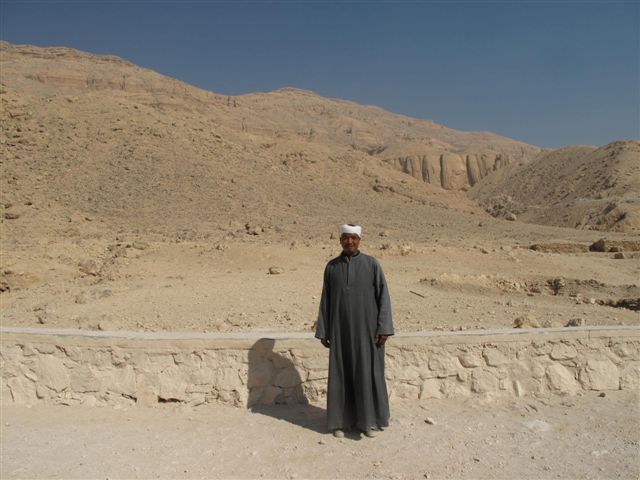
The cat was of course not there. The tomb guards and police were puzzled about my visit but when they understood the purpose of my visit, they tried to search for the cat for me. The name of the  guard that the cat was following was Ibrahim. He told me in broken English that the cat was there in the morning and may have gone up the hills to eat something or gone sleeping somewhere. I looked up-vultures were hovering around near the top of those hills..

"Yesterday was cat but no camera. Today was camera but no cat". Ibrahim summarized my predicament with the feline race.
Cat Server Ibrahim Valley of Queens 
 I had to catch my plight out of Egypt so I appealed to Ibrahim to take a photo of the cat with his phone camera and emailed it to me. He must have taken sympathy for me and readily agreed. I felt imposing on him and offered him a small baksheesh, which is expected and asked for by almost everyone that a foreign tourist encounters. But to my complete surprise, he tried to decline it and I could even detect some embarrassment on his face.

Maybe, the cat chose Ibrahim for a reason..

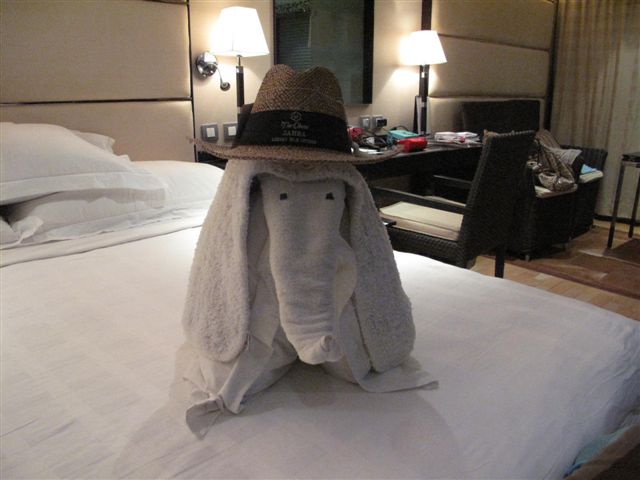
P.S. Oberoi Towel Art:


Monday, 4 July 2011

United We Fight for the Survival of the Wild Cats

I was invited to give a keynote speech at the 40th Annual & Anniversary Conference of FCF (Feline Conservation Federation of America) on June 11th in Orlando, Florida. FCF is an organization whose members are private owners of exotic cats for conservation and education purposes: http://www.felineconservation.org

It was good to be among kindred spirits and these cat owners are all devoted to their exotic friends, big or small and they are essential in educating the American public about wildlife and endearing them to animals. I was truly honoured to share our project’s experiences with them. I met some very interesting people and some very interesting cats there too. It was also interesting to know that some oppositions they face are similar to ours and come from the same sources.

Here are a few photos from the event.


TigerLi and FCF advocates


Gift of Handmade artwork to TigerLi from FCF members


Visit to Joel Slavens Animal training facilities


Jean, TigerLi, Dr Sanderson and Mindy


Tiger cub


Dan, Dr Sanderson, and TigerLi


Bobcat kittens


Eden Tran & Madonna Painting


FCF Doc Antle


TigerLi

Monday, 22 November 2010

Goodbye Snarl?


Nov 19th, 2010

THE world's small cat authority, Dr. Jim Sanderson told us in September during our Rewilding Workshop that the caracal Snarl who had been under our care since last year looked strong and mature enough to be released back in nature and suggested we radio-collar her as well before releasing her. We started preparation immediately afterwards.

Our chief scientist Petri organised the re-fitting of an old collar once used by Cathay which was ready and sent back to Laohu Valley by the manufacturer just before our planned release time for Snarl. Petri and Hein tested the radio collar, tracking receiver and antenna- all working fine.

In order to put the radio-collar on her, we would need to sedate her. Though about third bigger than an average domestic cat, the caracal is strongly built with powerful legs and muscles and can do serious damage if she feels threatened by us monstrous sized humans.

Therefore it was not an easy task to put the radio collar on Snarl. Our Reserve Manager Hein built a trap cage and a few days before the collaring and release, the cage was introduced into Snarl's enclosure with food inside, in order to entice her into the cage. The plan was to make her comfortable going inside the cage to retrieve food for a few days. Then during the day before she was due to be released, food was put much deeper inside the cage so her body will have to be completely inside to retrieve it, which would actually activate the trap that triggers the cage door to drop, closing the cage.


All went according to plan and Snarl ended up closed inside the cage today. The Vet Gavin, who was very resourceful in treating Madonna's dehydration a few years back (he used a blanket to capture Madonna), was recruited to sedate Snarl with anaesthesia so she can be radio-collared. Gavin and his wife arrived at 3pm punctually, after one hour's drive from his clinic in Colesburg.

To avoid doing damage to the caracal, Gavin chose to apply contact-injection, in lieu of darting her with a dart gun. He was worried that the dart gun's strong force might fracture Snarl's leg if the dart went into the wrong place, which was not unlikely given that she was extremely agitated with human presence. Gavin's invention worked. He tied an old nylon bag to two strands of steel wires and pushed the bag into Snarl's cage. Snarl, not knowing what this large white-ish thing was, backed into the end of the cage, making it easy for Gavin's wife to inject her with sedative.

An antidote was applied quickly as soon as the caracal was collared and Snarl woke up soon after. She was still drowsy so we waited till about sunset time to release her when it was cooler.

We loaded up the cage to the back of the truck and drove to an area about one km from Hein's house, where a little stream runs with a lot of trees for cover. Snarl certainly didn't know she was going to be free, snarling along the way and trying to attack our us when we carried her cage.

She was about 4 months old when Snarl was brought to us, her mother poisoned by farmers. Caracals are formidable hunters and can take down a sheep in no time. They can even take down a blesbok which is probably at least 6 times their body size. Farmers continue to poison them as well as other smaller predators such as jackals in our area to protect their livelihood.

Snarl was wild and got her name because of her non-stop snarling when humans are present. Although she calmed down a bit, it was not possible to tame her. So we had to take the decision to release her back into the wild instead of letting her spend the rest of her life inside the enclosure. Thankfully, even those hand-reared caracals are known for their wild survival ability. We waited till she would be 1.5 years of age, fully grown so she would be able to deal with competitors such as jackals or other even other caracals. Meanwhile, we started training her to eat wild animal carcasses.

Now, while time had come to open the cage door so she could be free, I wondered how she would survive her first night? Where would she make her territory? Would she stay in this release area, go far away or return to Hein's house? How soon would she be able to hunt? Snarl's pretty little face with beautiful, shining and intelligent green eyes stared at us with hatred, and rightly so. We humans killed her mother, making her an orphan. Now she has to learn, all on her own, how to fend for herself.


We opened the cage door telling her to go out into freedom, expecting her to dash out and disappear into the trees. But she was not aware of her predicament, snarling at us continuously without budging. We had to move the cage eventually to leave her out of it. She turned around to look, suddenly realising she was no longer confined. Crouched low, she slunk away towards the densely forested little stream.

I repeated to her, "Go Snarl, Go! You are free". Inside my heart, I was tortured by the desire to have glimpses of her again, and the hope she can strike it out on her own in the wild.

Nov 22 2010

Hein went early the next morning to check on Snarl's movement again. She moved about 1 km away from the release spot within 6 hours of her release, but walked a only few hundred more meters overnight. The food left for her during her release was untouched. Hein even saw her standing on a cliff during his evening tracking.

Yesterday, she was found to be moving towards north, the springbuck carcass left for her was again untouched.

This morning however, no signal from her radio-collar could be detected. Where did Snarl go?

P.S.: a regular update of Snarl's radio-collar info map can be seen HERE.

Wednesday, 20 January 2010

“The Last South China Tiger”

Body Paint Tiger Art Donated to Save China’s Tigers

Famed body paint artist and photographer Craig Tracy created a stunning image of a South China Tiger in aid of Save China’s Tigers Rewilding and Reintroduction project, and to mark the onset of the Chinese Year of the Tiger, coinciding with the Valentine’s day this year.

The awareness campaign has been organized by Save China’s Tigers, a charitable foundation dedicated to saving the Chinese tiger, as well the entire eco-system in which it presides as the King of Beasts.

“I initially wanted to call for volunteer models to come forward and have their body painted into tigers to produce a 2010 calendar along with real tiger images. But upon seeing Craig’s breathtaking work in a local newspaper, I thought this was just the right artist we needed, as Craig is two artists in one - painter and photographer”, describes Save China’s Tigers founder, Li Quan of the campaign which also celebrates the 10th anniversary of the charity. “I was pleasantly surprised to get a very positive and spontaneous reply from Craig, whose favourite animal is also the tiger”.

New Orleans based Craig Tracy said of his creation: “When I learned from Li Quan of the plight of the South China Tiger, I wanted to be part of the effort to rescue this most ancient tiger in the world and a cultural symbol of China from extinction.“

The South China Tiger is an iconic symbol in Chinese tradition and culture. This magnificent animal numbered less than 30 in the wild and around 80 in captivity, although some organizations have declared it extinct. The Chinese Year of the Tiger occurs every 12 years and it embodies courage, passion, self-reliance, friendliness, hope and resilience.

Tracy conceptualized the campaign, selected three volunteer models and donated this amazing image to Save China’s Tigers. Signed limited edition fine art prints of this image will be available in the art galleries that represent Tracy, who has pledged portion of all his proceeds to the South China Tiger Rewilding Project.

Tracy’s revolutionary painting technique titled “Painted Alive” incorporates the use of a live human bodies being painted and inserted into a background. A photo is taken creating his limited edition Fine Art. His style is ever evolving with each and every piece he creates.

Li Quan says, “I hope this stunning work will inspire people to help our cause.”

SCT is offering a Giclee photoprint on canvas for this amazing painting. Please visit SCT E-shop for purchase detail.


Wednesday, 30 December 2009

Snarl and Night Drive at Laohu


Over the years, I have seen more small wildlife in Laohu and its surroundings than any other national parks or private game reserves: aardwolves, porcupines (one often eats the tree bark at night outside my bedroom door), bat-eared foxes, meerkats, hares of all kinds, and even the very rare anteaters - once in slow motion zigzagging ahead of my vehicle.
My reserve staff have of course sighted other precious wildlife such as black-footed cats, african wild cats and caracals, which I have not had the pleasure of seeing in the wild and have been meaning to make an effort to see them. During this visit, I asked our Reserve Manager, Hein, to take me on a night drive to see if I would have the good luck of finding a black-footed cat, which fascinates me particularly as my cat Sisi probably has some Black-footed cat blood.
Hein has had a lot of experience in wildlife before he joined us. We set out after dinner at 8.30pm. All game were active now at night that the temperature had become very pleasant and they seemed to be less agitated than during the day. We could get very close to game probably because they don't see well in the dark. We saw elands, mountain reedbuck, kudos, etc, etc and herds of black wildebeests - some of them with twin calves. When we passed the tiger camps, Hein showed me the difference in reaction to lights between cat eyes and other eyes. When light is shone on cat eyes, their irises close. In the distance, we saw three pairs of lights in straight line dimming and brightening again, as our spot light shone on and off them - these were eyes of Hulooo and brothers.
In order to increase the chance of sighting the very shy black-footed cat, Hein has to call them. He does this by imitating the squeaking sound of mouse using his own lips, or blowing distress calls of rabbits on a predator whistle. In the first round of calls, he got the attention of an aardwolf. Hein also blew jackal howls on the whistle to which real jackals would respond by howling back, but not tonight, as its breeding season and they are nurturing the young in their dens.
After the second round of whistle blowing at another spot, about 9 bat-eared foxes came from different directions to investigate. They were curious little animals with big ears. They ran off as soon as they realized there were no distressed rabbits.
Still no black-footed cats on my sighted list, I had to contend visiting "Snarl". She is a 8/9 month old orphaned caracal whose mother was poisoned by local farmers and who was saved by a friend of Hein. We offered to take her so she could leave the small cage behind and live in a big enclosure. Four months ago, when I first saw her, she was hissing and spitting. It is very hard to tame a wild cat after she has opened her eyes around 10 days of age and the first object she sees is her mother. The power of caracal is legendary - its the fastest land animal by body weight and size, and they can take down a springbok several times their body size piecemeal. I had seen a tame one jumping in one leap to the top of a room door.
Now that Snarl has moved into her large enclosure, she hid herself under the little rock cave, snarling at us but looked a lot calmer compared to being in that small cage. What happened next surprised us all. Hein was watering the grass in her enclosure with a water tube, while suddenly Snarl dashed out under the shower to cool herself down! She dashed back to her hideout afterwards, licking herself dry with contentment.
Our plan is to rehabilitate Snarl and release her back into nature at her natural dispersal age about 20 months old. Thankfully, like most small wild cats, their hunter instinct seem to be stronger and it would be much easier task to send her back to the wild successfully than the tigers!

Thursday, 17 December 2009

327 Finally Became Dad!


I was exhausted but not able to fall asleep, watching the clock reaching 2am, 3am in the hotel room in Johannesburg. During dinner with Consul General of Johannesburg and other friends, I talked about Cathay being probably pregnant and if so, might be giving birth any time. Now lying in bed, I somehow had the premonition that Cathay may have already given birth and I was counting the hours so I could call our team at Laohu to find out first thing in the morning.
I only fell asleep around 7am in the morning and the first email I saw coming in when I woke up at 10am, told me that baby tiger cry was heard from the trees in Cathay's camp in the late afternoon the previous day ( Dec 16 , 2009) and Cathay had indeed given birth!
After we had almost all given up on his male power, 327 - this city born and city groomed stud, has now vindicated himself and become a father!
327 came a long way. A few months after he arrived at Laohu, we had him to make acquintainces with the two ladies. But he was terrified of Cathay and somehow indifferent to Madonna. We somewhat lost hope. Then we discovered one of his testicles is much smaller than normal, in fact almost invisible! Although we are told this should not stop him from being able to mate or being fertile, but coupled with the fact he did not seem to have much interests in the females, it cast doubt on his abilities nevertheless.
Eventually I had him moved out of the breeding centre and he settled in the 3 ha "grass camp". Initially he would come to greet whatever humans come his way, like he used to do in the breeding centre, and trotting along the fence. After a while he seemed to become indifferent to humans and only came to greet if he was hungry. I was delighted by his change of attitude-perhaps he had some hope!
After separating Cathay from her sons JenB and Coco in August 2008, I was hoping she would come into oestrus in a few months but she kept us waiting and waiting. By Feb this year when she still had not come into oestrus, I decided to rotate her between TigerWoods and 327 and let her spend some time with 327. In the wild, a male tiger could reign his territory for a while but get pushed out by younger and stronger new male, so the tigresses in a male's territory have access to new stud and thus new genetic materials every few years. This also keeps the tigresses' interests in mating and breeding strong.
It came as a nice surprise that the meeting between 327 and Cathay was friendly, unlike their previous encounters. It was further a pleasant shock when 327 and Cathay mated in June this year. I was on the one hand hopeful and on the other hand uncertain about Cathay getting pregnant from 327, and I was indeed terribly disappointed when she came back into oestrus the tenth week after she had mated with 327 - proving he was not able to impregnate her.
Against the advice of others and heeding the traditional Chinese wisdom of "three opportunities", she was allowed to meet 327 when she came back into oestrus at the end of August and demanded being let in with him, even though she was with TigerWoods at that time. What followed after is history. A heated three-day love fest between the two resulted in 327 becoming a Dad, at the age of seven years.